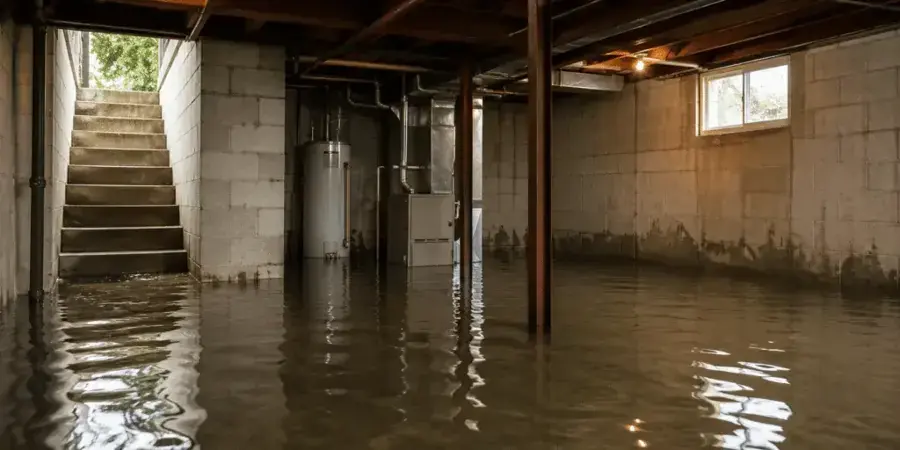
A basement can take on water without a storm warning, a burst pipe or a failed pump. In Blue Springs the cause is often the ground itself, which swells with spring rain and leans on the foundation.
Key takeaways
- Expansive clay around many Blue Springs foundations holds water against basement walls after spring and early summer storms.
- Seepage at the base of a wall, water at a walkout door and a pump overflow look alike but need different fixes.
- May and June are the wettest months, so the first signs often show up in late spring.
- Wet carpet pad and the bottom of the drywall go first; concrete and framing need drying too.
- Extraction comes first, then moisture readings decide what stays and what is removed.
Why clay soil pushes water against Blue Springs basements
Blue Springs sits on expansive clay. When spring rain soaks that soil, it swells and presses on whatever is next to it, including a basement wall.
The city grew from under 7,000 people in 1970 to more than 40,000 by 1990. Most homes from that growth are ranches, split-levels and two stories built over full or walkout basements.
Newer subdivisions toward Grain Valley added more of the same layout. A house of any of these ages can see water at the wall when the ground stays saturated for days.
- Spring and early summer thunderstorms bring hail and heavy downpours.
- May and June are the wettest months.
- Wet clay holds water longer than loose soil, so seepage can continue after the rain stops.
- Hairline cracks, the joint where the wall meets the floor and window wells are common entry points.
Reading the wet spot: seepage, door water or something else
The location of the water tells the restoration team a lot before any tool comes out. A few quick checks sort most cases.
The goal is not a perfect diagnosis on the first look. It is to decide where to start extracting and what to keep an eye on while the work goes on.
Seepage at the base of a wall
Water that beads or darkens the bottom of a wall, usually along one side, points to ground water pressing through the concrete. It often shows up at the joint where the wall meets the slab.
The carpet pad and the bottom of the drywall wick it upward, so a small wet patch can hide a larger wet area.
Water at a walkout door or a window well
Walkout basements have a door at yard level. When the yard slopes toward it, or the drain outside clogs, rain pours in under the threshold.
A window well that fills with runoff can push water past the window frame in the same way.
Water that is not seepage
A wet spot near the water heater, the washer or a furnace drain is a plumbing or appliance problem. A sump pump that quit leaves water in the pit and across the floor around it.
The cleanup is similar, but the source has to be found or the water comes back.
- Water near the water heater or washer: check the tank base and the hose connections.
- Water around a sump pit: check whether the pump runs and the discharge pipe is clear.
- Water on one wall only after rain: likely ground water.
The first day after seepage starts
Basement water does not stay put. It runs under walls, soaks stored boxes and climbs drywall, so the first day matters more than the first week.
These steps keep a bad situation from growing while the restoration team is on the way.
- Turn off power to the basement at the panel if water is near outlets, and stay out of standing water.
- Lift boxes, rugs and furniture off the floor and onto plastic or blocks.
- Photograph the wall, the floor and every damaged item before moving things.
- Run a wet vacuum on small puddles and open windows only if the rain has stopped.
- Do not use the household vacuum or fans plugged into outlets that sit in wet areas.
What extraction and drying involve
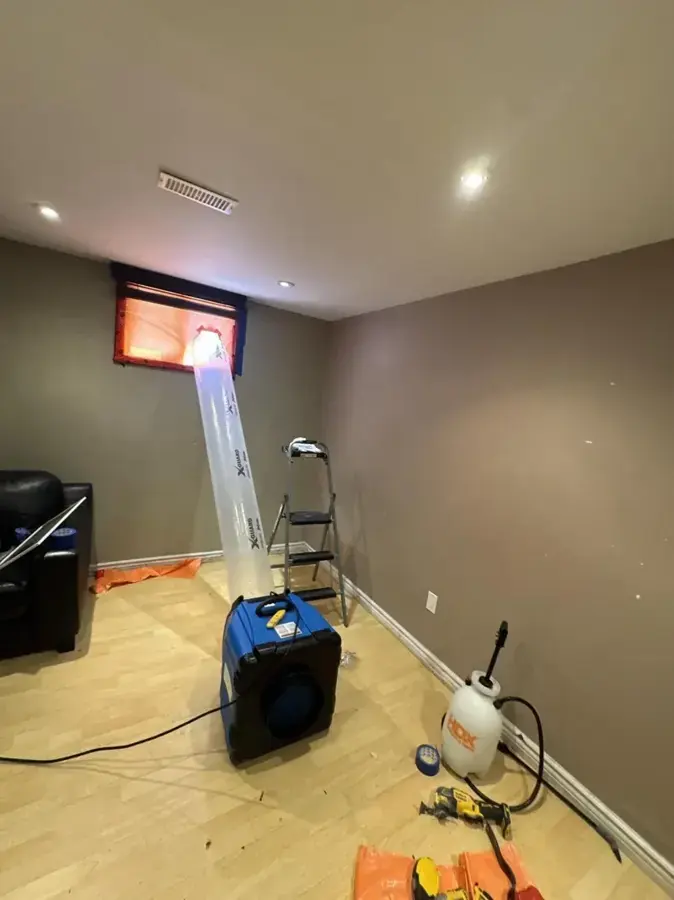
The extraction crew starts by removing standing water with pumps and wet vacuums. Even a thin film on a concrete floor holds a lot of moisture, so it is lifted instead of left to evaporate.
Then the drying team measures the wall, the baseboard, the framing and the slab with a moisture meter and a thermal camera. Those readings show where water went that the eye cannot see.
Drying equipment goes in to pull moisture out of materials and the air. Readings are taken again each visit until the structure reaches a dry standard.
Details on the basement flooding cleanup and water extraction services explain how the work is sequenced.
- Carpet pad is usually discarded; carpet can sometimes be saved if lifted quickly.
- Drywall that wicked water above the base is cut out, often a few inches above the wet mark.
- Insulation behind the wall is removed if it is wet.
- Concrete and framing stay and are dried in place.
What stays and what goes
Porous materials that soaked up ground water are harder to save than hard surfaces. Seepage carries soil and bacteria, so the water is treated as contaminated, not as clean supply water.
The restoration team sorts items into three groups: dry and keep, dry and clean, and discard.
- Keep: sealed plastic bins, metal shelving, solid wood furniture that is cleaned and dried.
- Clean and dry: finished walls that can be cut and rebuilt, concrete, framing.
- Discard: soaked carpet pad, wet insulation, cardboard boxes, particleboard.
- Photograph discarded items for the claim before they leave the house.
Mold and the 24 to 48 hour window
Mold can begin growing on wet drywall and framing in 24 to 48 hours. That is the reason the drying team works through the first days instead of waiting for the wall to dry on its own.
Notes that help an insurance conversation
Policies treat ground water, surface water and plumbing leaks differently, so the source of the water matters to the claim. A homeowner should read the policy or ask the agent how seepage is handled.
A clear record of what happened helps the owner and the insurer reach the same picture of the loss, whatever the answer turns out to be.
- Write down when the water was first seen and which wall or door it came from.
- Keep a short log of rainfall days and any power outages that came before it.
- Save receipts for pumps, rentals and anything thrown away.
- Ask the restoration team for its moisture readings and a list of the materials removed.
Cutting down repeat seepage
Not every wet basement can be prevented, but a few habits lower the odds of a repeat. None of these replace a plumber or a foundation contractor when a wall is cracked.
The drying team can note where water entered and point out what to ask a contractor about.
- Extend downspouts so roof water lands well away from the foundation.
- Keep the yard sloping away from the house and clear window wells of leaves.
- Test the sump pump before the wet months and keep the pit clear.
- Move stored items onto shelves instead of the floor.
- Check walkout door seals and the drain outside the door after a heavy rain.
Questions
Why does a Blue Springs basement leak when it has not flooded before?
Clay soil swells as it soaks up spring rain and presses on the wall. A basement that stayed dry in a dry year can seep in a wet May or June.
Is seepage water clean?
No. It carries soil and bacteria from the ground, so it is handled as contaminated and porous materials that soaked it up are usually removed.
Can wet carpet be saved after seepage?
Sometimes, if it is lifted and dried quickly. The pad under it almost always has to go because it holds water and cannot be cleaned well.
How long does a basement take to dry?
It depends on how much water entered and what the walls and floor are made of. The drying team takes moisture readings each visit and stops when they meet the dry standard.
Should the walls be opened even if they look dry?
Often yes, a few inches above the wet mark. Moisture readings and a thermal camera show whether water climbed behind the drywall.