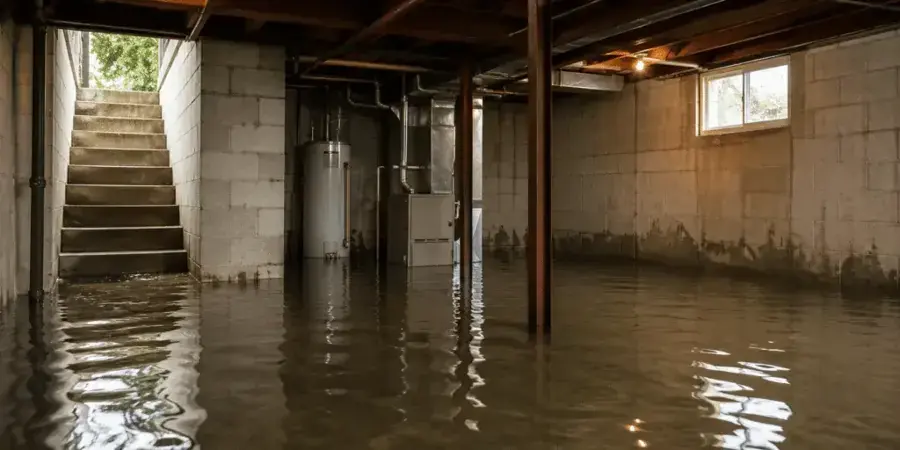
In July 2025, flash flooding severely damaged or destroyed roughly 20 Independence homes and affected dozens of families. Many more homeowners dealt with a wet basement and no clear idea where to begin.
Key takeaways
- Roughly 20 Independence homes were severely damaged or destroyed in the July 2025 flash flooding, and dozens of families were affected.
- The city says urban flooding can turn streets into fast moving rivers and fill basements with water.
- Water can enter through a sump pump or a washer drain, not only through walls and doors.
- The city says about 30 percent of FEMA claims come from outside the 100-year flood zone.
- Standing water comes out first, then moisture readings decide what is cut out and what is dried in place.
What the July 2025 flooding showed about Independence basements
The July 2025 flash flooding hit homes across Independence and left some of them unlivable. A center for flood victims opened on August 2, 2025 at the Fairmount Community Center.
One Independence family reported basement water that came up through a sump pump and a washer drain and left a mark about two feet up the wall. That detail matters because it shows water does not need a crack or an open door.
The city describes urban flooding as water that can turn streets into fast moving rivers and fill basements.
- Water can rise through floor drains, sump pits and washer standpipes when the ground and the sewers are overloaded.
- Window wells and basement stairwells fill when rain runs toward the house.
- A sump pump cannot keep up when the water outside rises faster than the pit can empty.
Where flood water comes from in Independence
The city says flooding occurs principally in the Little Blue River Valley and along portions of Rock Creek, Spring Branch and Adair. The city also lists 24 watershed areas, and its borders reach north to the Missouri River.
Storm water in Independence goes straight to local creeks and rivers without treatment. That is one reason flood water in a house is treated as contaminated.
Not only inside the flood zone
The city notes that about 30 percent of FEMA claims come from outside the 100-year flood zone. A home that is not on a flood map can still take in water.
A homeowner should not wait for a map to confirm a loss before starting cleanup and documentation.
Flash flood water versus a plumbing leak
Flash flood water carries soil, debris and whatever the sewers and yards pushed into it. A burst supply pipe puts clean water into the house, which is a different kind of job.
The category of the water changes what can be dried and what has to be thrown away.
The first day in a flooded Independence basement
Safety comes before saving belongings. A basement with water over outlets, a furnace or a panel can shock someone who walks in.
These steps fit most flash flood basements.
- Stay out of standing water until the power to that level is off at the panel.
- Do not step into deep basement water; floors can be slick and hidden objects float.
- Photograph the water level on the wall and every damaged item before anything moves.
- Lift valuables and papers to upper floors.
- Wear boots and gloves when handling anything that touched the water.
- Keep children and pets out of the area.
How the extraction crew removes the water
The first job is getting standing water out. The extraction crew uses pumps for deeper water and wet vacuums for the last film on the floor.
The sooner it leaves, the less it soaks into drywall, wood and carpet.
When the water is deeper than a few inches, it is lowered in stages. Removing it too fast can push on basement walls, so the crew works with care when the soil outside is still saturated.
More about this work is on the Independence water extraction page.
- Pumps and wet vacuums remove standing water.
- The drying team opens the floor drain and sump pit and looks for debris.
- Mud and silt are shoveled and bagged.
- Wet carpet and pad are cut and removed.

Drying what is left and deciding what to remove
Once the water is out, the drying team measures the walls, the slab and the framing with a moisture meter and a thermal camera. Those readings show how far the water climbed.
Flood water is treated as contaminated, so porous materials that soaked it up are usually removed. Hard surfaces and concrete are cleaned and treated, then dried.
The basement flooding cleanup work in Independence follows that order: remove, clean, dry, then verify with readings.
- Carpet, pad and insulation that were soaked are removed.
- Drywall is cut above the wet mark so the cavity can dry.
- Drying equipment runs until the readings reach a dry standard.
- Mold can start in 24 to 48 hours on wet materials, so the first days count.
Public sewers, storm drains and what a homeowner can see
Independence runs separate sanitary and storm sewer systems. The Sanitary Sewer Maintenance Division maintains the sanitary sewers, and the Storm Water Division maintains the storm sewers.
When a basement floor drain bubbles during a storm, the water may have come from the sanitary side. A homeowner cannot tell by looking whether the problem began in the street or in the house, so the first goal is to stop using water and get the standing water out.
The city has spent years working on sewer overflows, including a March 2009 agreement with EPA and the Department of Justice aimed at ending sanitary sewer overflows. That is background, not a prediction about any one storm.
- Avoid running the washer, dishwasher and showers while a drain is backing up.
- Note where water first appeared: floor drain, sump pit, wall or door.
- Tell the restoration team what came up through which drain, since it changes how the water is classified.
Documentation, insurance and the sewer question
Standard policies often treat flood differently from other water losses, so a homeowner should ask the insurer before the work starts and keep every record.
In the same July 2025 weather, sewage backed up into homes in the Salem East neighborhood after more than six inches of rain, and the city said the heavy rain was the primary cause. A basement that took in sewer water needs the sewage backup cleanup approach instead of a plain flood job.
- Photograph the water level, damaged items and the source if it can be seen.
- Keep receipts for pumps, rentals, hotel stays and replacements.
- Ask the restoration team for moisture readings and a list of removed materials.
- Report damage to the insurer in writing.
Lowering the odds of the next flood
City flood guidance suggests a few steps for homes that have taken in water. They do not make a house flood proof, but they help.
The city recommends a sump pump with a discharge hose that does not drain to the sanitary sewer, and downspouts that are never connected to the sanitary sewer. It also suggests a backflow prevention device on the sewer lateral or floating floor drain plugs, and raising the furnace and water heater off the floor where flood water has entered a basement.
- Check that the sump discharge hose runs outside and away from the house.
- Confirm downspouts empty onto the yard, not into a drain that leads to the sanitary sewer.
- Ask a plumber about a backflow device or floating floor drain plugs.
- Store belongings on shelves and keep valuables upstairs.
Questions
Why did my Independence basement flood if I am not near a creek?
The city says about 30 percent of FEMA claims come from outside the 100-year flood zone. Heavy rain can overwhelm drains, sump pumps and sewers in any neighborhood.
Is flood water in a basement safe to touch?
No. Storm water goes to creeks and rivers without treatment, so flood water is handled as contaminated. Boots, gloves and a pause on electrical use are the basics.
Can a sump pump cause a basement to flood?
It can when the pump fails or cannot keep up. One July 2025 Independence basement took in water that came up through a sump pump and a washer drain.
Should I wait for the insurance adjuster before starting cleanup?
Photograph everything first, then start extraction. Waiting lets the water soak in and make the loss bigger.
Does the drying team remove drywall?
Often, a few inches above the wet mark or more if the readings show wicking. The decision depends on moisture meter and thermal camera results.