
Water that appears in a basement or against a foundation does not always come from inside the house. In Lee's Summit it can come from the pipe that runs from the street to the building.
Key takeaways
- The city says the property owner is typically responsible for the water service pipe from the building to the meter.
- A break in a public water main is the city's repair; a break on the owner's side is the owner's.
- Repairing or replacing an existing water or sewer pipe has its own permit through the city's CityView portal.
- A failed service pipe can flood a basement, crawl space or yard-side wall before anyone sees a leak outside.
- Extraction and drying start as soon as the water is shut off at the right valve.
Where the city's job ends and the owner's begins
Lee's Summit Water Utilities provides water and sewer service to nearly all buildings in the city. The utility buys treated water from Kansas City and Independence, which both draw from the Missouri River.
The city says property owners are responsible for the sewer lateral and the water service pipe, including inspection, cleaning, maintenance and repair. For the water side, the owner is typically responsible from the building to the meter.
In practice that means a main break in the street is the city's to fix (the Lee's Summit water damage pros see both kinds of loss), while a split in the pipe between the meter and the house is on the owner.
- City: public water mains and the meter.
- Owner: the water service pipe from the meter to the building.
- Owner: plumbing inside the house, including the shutoff valve and fittings.
- City news has reported water main breaks, such as one in June 2026 that closed a section of pavement for repair, which shows the public side is separate.
Signs the service pipe has failed
A failed service pipe often leaks underground, so the first sign may be indoors. Water can follow the pipe along its path and enter the house at the foundation wall.
Signs outside
Soft, wet or sunken ground between the street and the house points to a leak in the yard.
Water pooling near the meter or the foundation after dry weather is worth checking.
- Wet ground with no rain
- Sunken soil above the pipe
- Low pressure or a loud hiss near the meter
Signs inside
Damp spots at the foundation wall where the pipe enters, a wet basement corner or a crawl space with standing water can all trace back to the service pipe.
A water meter that keeps moving when every fixture is off is a strong sign of a leak somewhere on the owner's side.
- Wet basement wall near where the pipe enters
- Standing water in a crawl space
- Meter dial moving with everything off
Shutting off the water without making it worse
The first move is to stop the water. A homeowner should know where the main shutoff inside the house sits, and where the meter valve is.
If the break is on the owner's pipe, closing the shutoff inside the house stops the flow into the house. Some leaks sit between the meter and that valve, which means the meter valve may be needed.
- Find the main shutoff inside the house and close it.
- Turn off the water heater if the water supply is interrupted.
- Turn off power to wet areas if water reaches outlets.
- Photograph the wet area, the meter and any visible damage.
- Call a plumber for the pipe repair; the restoration team handles the water.
Permits, plumbers and the repair itself
The city requires building permits for most construction, alteration, repair and installation projects, and repairing or replacing an existing water or sewer pipe has its own permit through the CityView portal.
That is a plumber's step, not the restoration team's. The two jobs run side by side: the plumber fixes the pipe, and the extraction and drying team handles the water that got into the house.
A homeowner should ask the plumber about the permit before work starts and keep the paperwork with the claim file.
- Ask whether the plumber has pulled the permit.
- Keep the invoice and the permit record.
- Ask the plumber to note the pipe's condition and the point of failure.
- Tell the restoration team where the water entered so it can trace the path.
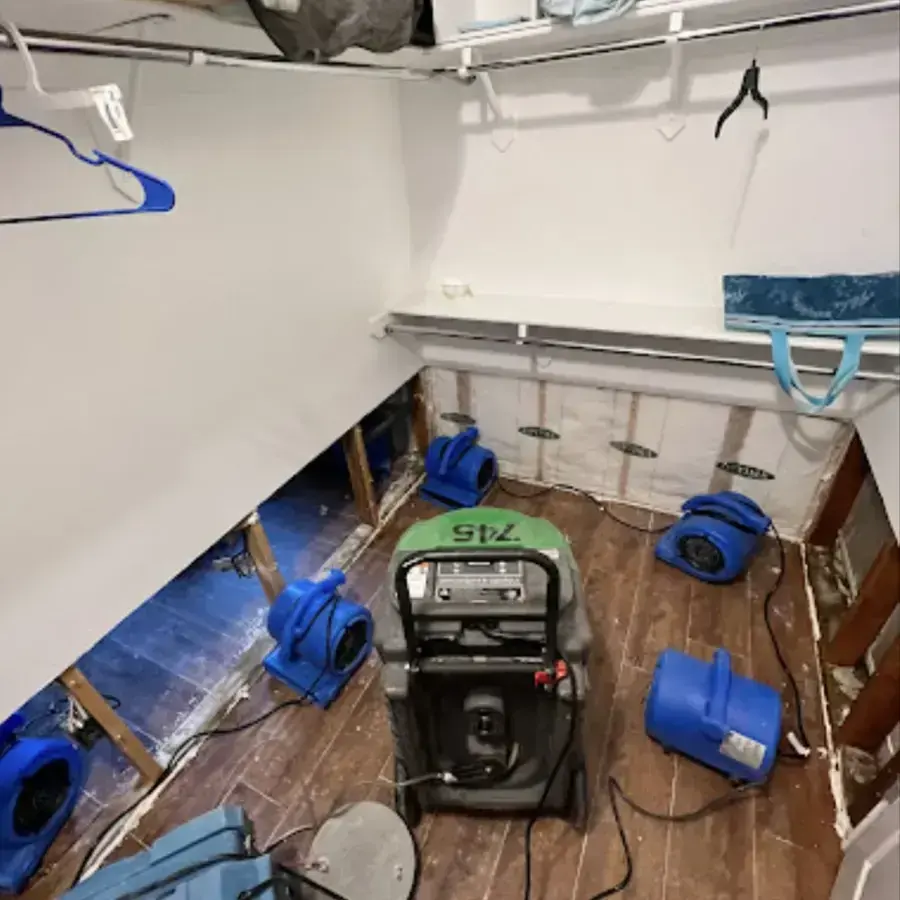
What the cleanup looks like
When a service pipe fails near the foundation, water may enter through the wall, under the slab or into a crawl space. It is clean supply water at first, but it picks up soil and dirt along the way.
The extraction crew pumps standing water out and checks the area around the entry point for hidden pockets. The drying team then takes moisture readings in the wall, the floor and the framing.
Details on the work are on the Lee's Summit burst pipe water damage and water extraction pages.
- Standing water is pumped or vacuumed out.
- Wet carpet pad and insulation are removed.
- Drywall is cut above the wet mark if it wicked water.
- Drying equipment runs until readings meet the dry standard.
- Mold can start in 24 to 48 hours on wet materials, so the first days count.
Water in the yard side of the house
Not every service pipe break floods the basement. Some leak into the yard, wash soil away from the foundation and show up as wet stone or siding at the base of an outside wall.
A yard leak still counts as water damage if it reaches the wall cavity or the floor framing. The drying team checks the exterior wall and the first floor above it.
A pipe that has been running for a while can soften the ground and shift a deck or a step, so a plumber's inspection and a moisture check are both worth having.
Insurance and the owner's responsibility
Policies differ on pipes outside the house. Some cover the interior damage and not the cost of digging up the yard, and others offer optional coverage for the service pipe.
A homeowner should ask the agent before the repair starts.
The city also says that if a sewer lateral fails under a street, the owner is responsible for the repair and for damage to the street or other public improvements. That is a separate pipe, but it shows the owner side can carry real cost.
A matching burst pipe water damage page covers pipes inside the house.
- Photograph everything before cleanup starts.
- Keep the plumber's report and the restoration team's moisture readings.
- Ask the agent how outdoor pipe repair and indoor water damage are treated.
- Check the permit paperwork with the plumber.
Questions
Who fixes a water service pipe break in Lee's Summit?
The city says the owner is typically responsible for the pipe from the building to the meter. A break in the public main is the city's job.
Does the city repair a pipe that leaks between the meter and my house?
That section is typically the owner's responsibility, so a homeowner should hire a plumber and ask about the permit.
Do I need a permit to replace a water service pipe?
The city says repairing or replacing an existing water or sewer pipe has its own permit through the CityView portal. The plumber usually handles it.
What does the restoration team do while the plumber fixes the pipe?
The team removes the standing water, opens wet materials and dries the space, while the plumber repairs the pipe.
How can I tell whether the leak is on my side?
A meter that moves with everything off, wet ground between the meter and the house, or damp foundation walls point to the owner's side. A plumber can confirm.