
A sewer backup does not announce itself with a leak. It shows up as dirty water rising out of a floor drain, and in finished basements the damage spreads fast.
Key takeaways
- A March 2023 KCTV5 report described a city sewer main clog that sent sewer water up floor drains into four connected Raytown townhomes.
- The water sat in those finished basements about two days, and drywall and carpet had to be removed.
- Sewer water is Category 3, so porous materials that touched it are removed, not dried.
- The City of Raytown said it does not cover sewer backups, so cleanup cost fell to the homeowners or their backup coverage.
- Photographs, a list of damaged items and the restoration paperwork support an insurance claim.
What happened in the Raytown townhomes
In March 2023, KCTV5 reported on a sewer backup that hit four connected townhomes in Raytown. A clog in a city sewer main sent sewer water up through floor drains into finished basements.
The water sat in the basements about two days, until city crews returned on Monday and cleared the main. Homeowners said drywall and carpet had to be removed at a cost of between 7,000 and 17,000 dollars each.
The case is useful because it shows how a backup works: the problem started outside the homes and the damage landed inside them.
- The source was a clog in a city sewer main, not a pipe inside the townhomes.
- Floor drains in the basements were the path the water took.
- Finished basements held carpet and drywall, which soak up sewer water.
- The water stood for about two days before the main was cleared.
Why a floor drain backup is a Category 3 loss
Water that comes out of a sewer drain is classified as Category 3, the most contaminated category. It can carry bacteria and other pathogens, so it is never treated like clean water from a broken supply pipe.
That classification changes the work. Materials that cannot be cleaned deeply are cut out and thrown away, and surfaces that stay are cleaned and treated.
What gets removed
Carpet and pad that touched the water are removed because they cannot be made safe again. Drywall that wicked contaminated water is cut out above the wet mark.
Insulation and any particleboard cabinets or stored cardboard are discarded for the same reason.
- Carpet, pad and baseboard
- Drywall that touched or wicked the water
- Wet insulation and cardboard
- Particleboard furniture and shelving
What can stay
Concrete, framing, metal and sealed hard surfaces can usually be cleaned and treated, then dried. The drying team confirms with moisture readings.
The first day after a floor drain backs up
The first priority is protecting people. Sewer water can make a household sick, and a flooded basement can hide electrical hazards.
These steps fit most basement backups.
- Stop using sinks, toilets, showers and the washer until the drain is clear.
- Keep children, pets and anyone who is ill away from the basement.
- Turn off power to the basement at the panel if water reaches outlets or equipment.
- Wear boots, gloves and a mask if anything must be moved.
- Photograph the water, the drain and every damaged item before anything is touched.
- Do not use a household vacuum on sewer water.
Whose problem is the backup?
In the Raytown case, the City of Raytown said its insurer found the city not liable because Missouri law requires prior knowledge of a problem, and that the main had been flushed in May 2022. The city also said sewer backup coverage exists for homeowners because the city does not cover sewer backups.
The point for a homeowner is practical. A backup can start in a city main and still end up as the owner's cleanup bill.
The city also said Public Works handles sewer problems after hours, so a homeowner should report a backup right away.
- Report the backup to the City of Raytown so the main can be checked.
- Ask the insurance agent whether the policy has sewer backup coverage before a loss happens.
- Keep every receipt and photo to support the claim.
- Ask neighbors whether their drains are backing up too, since a clogged main can reach several homes.
How the cleanup and drying work
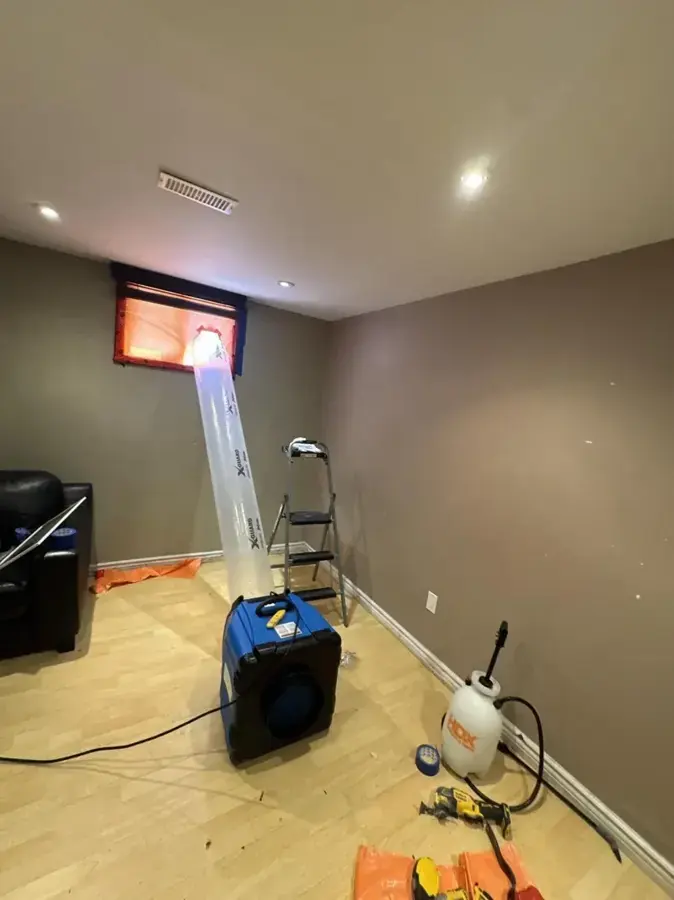
The extraction crew removes the water first, then the contaminated materials are cut out and bagged. Surfaces are cleaned and treated with an antimicrobial approved for the job.
After that, the drying team sets equipment to dry the slab and framing. Moisture readings are repeated each visit until the structure meets the dry standard.
More detail on the process is on the Raytown sewage backup cleanup and structural drying pages.
- Standing sewer water is pumped out.
- Contaminated porous materials are removed and bagged.
- Hard surfaces are cleaned and treated.
- Drying equipment runs and readings are logged.
- Mold can start in 24 to 48 hours on wet materials, so the first days count.
Telling a backup from a slow drain
Not every gurgle is a sewer main problem. A single slow sink usually points to a clog in that pipe, while several fixtures acting up at once points further down.
A floor drain that bubbles or lets water up is a stronger sign that the main or the pipe leaving the house is blocked.
- One slow sink or tub: usually a local clog.
- Toilets bubbling when the washer drains: the main drain may be blocked.
- Water rising in a floor drain or shower in the basement: treat it as a backup.
- Neighbors with the same trouble: the sewer main may be involved.
Connected townhomes and shared walls
In the Raytown case, four townhomes were connected, and each one had a finished basement. When homes share walls or run side by side, water and the damage can pass along floors and framing.
Owners in connected buildings should tell neighbors, the owners association or the property manager early. A single plumber visit and a single restoration walkthrough can cover more than one unit.
Ask the restoration team to check the shared wall and the floor near it, even if the neighboring unit looks dry. Moisture meters read what the eye cannot.
- Notify the association or manager as soon as water appears.
- Ask neighbors about drains, not only about visible water.
- Keep photos of shared walls and floors.
- Agree on one contractor visit where that makes sense.
Raytown homes and where a backup can reach
The city plan says almost 80 percent of Raytown's 13,307 housing units were built in the 1940s, 1950s and 1960s. Many homes from those decades have basements with floor drains.
Not every home has a basement, and this post makes no claim about how common they are. For homes that do, a floor drain is the lowest opening in the house and the first place sewer water appears when a main is blocked.
A backflow device on the drain, installed by a plumber, can help, and a homeowner should ask before assuming the home has one. Local Raytown water damage pages list the services available.
Questions
Who pays when a city sewer main clogs?
In the Raytown case, the city said its insurer found it not liable and that sewer backup coverage exists for homeowners. Each situation differs, so the owner should ask the insurance agent early.
Can carpet be saved after sewer water?
Usually not. Carpet and pad that touched Category 3 water are removed because they cannot be cleaned deeply enough.
Is it safe to stay in the house after a backup?
The affected area should be avoided until cleanup is done. People who are ill, children and pets should stay away from the basement.
How long does a basement take to dry after a backup?
The drying team measures moisture each visit and stops when the readings meet the dry standard. The time depends on the amount of water and the materials.
Should I flush drains again to see if the clog is gone?
No. Using water while a drain is backed up can push more sewage into the house. Wait until the main is cleared and the drain runs freely.