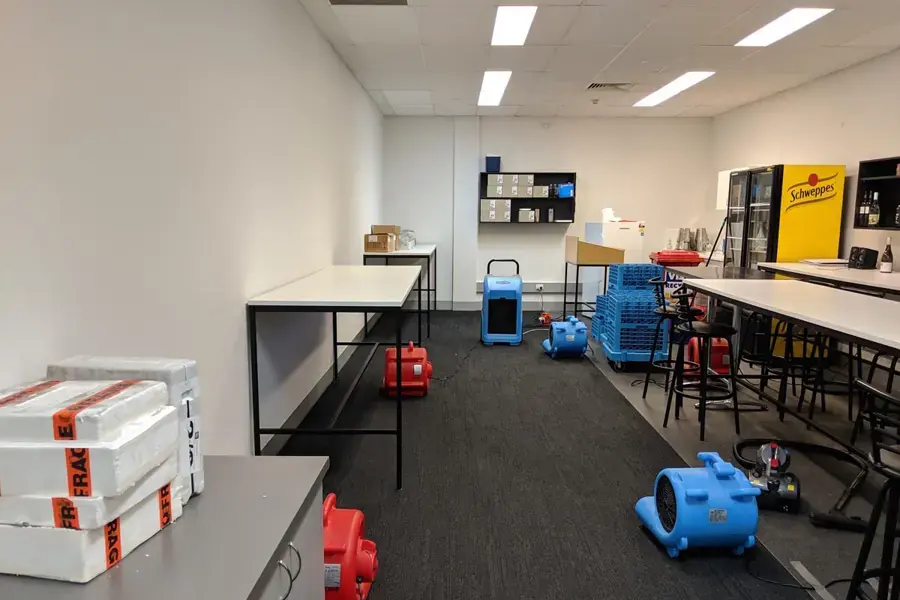
A water loss in a business costs more than a wet floor. Orders stop, tenants complain and stock sits in the path of the water.
Key takeaways
- Grain Valley has industrial parks along Interstate 70, Main Street shops, apartment buildings and the OOIDA headquarters, and each handles a water loss differently.
- The first moves are shutting off the water source, protecting inventory and records, and documenting the loss.
- Large buildings dry in zones, so work can continue while part of the building stays open.
- Landlords, tenants and managers each have a role, and the lease usually decides who handles what.
- Moisture readings, not appearances, decide when drying is done.
What kinds of commercial buildings Grain Valley has
Grain Valley is a bedroom community for the Kansas City metro area, but it also has real commercial and industrial space. Valley Ridge Industrial Park, north of Interstate 70, is fully built out, and East Kansas City Industrial Park is partly built out.
East Kansas City Airport is the largest industrial use south of Interstate 70. The Owner-Operator Independent Drivers Association, known as OOIDA, is headquartered in the city, and Main Street has shops in older buildings.
Grain Valley shoppers also use Adams Dairy Landing in Blue Springs and the Walmart Supercenter at the Oak Grove exit. The Grain Valley water damage pros work across all of these building types.
- Large footprint buildings in the industrial parks
- Shops along Main Street
- Apartment buildings and multi family housing
- Schools and civic buildings in the community
How water gets into a commercial building
The sources are different from a house. Roof drains clog, rooftop units leak, supply pipes burst and fire sprinkler pipes discharge, and a restroom overflow can run all night when nobody is there.
In a large building, a leak can run unseen across a slab or under a pallet for a long time. A slow loss in a back corner can end up affecting a whole tenant space.
Common sources
Roof leaks after wind or heavy rain, especially around drains, flashing and rooftop equipment.
Supply pipes, restroom fixtures, kitchen equipment and water heaters inside the building.
- Roof and roof drain leaks
- Burst or leaking supply pipes
- Restroom and kitchen overflows
- Rooftop and ceiling HVAC condensate
- Storm water that enters at a loading dock or door
After hours losses
Many commercial losses happen when the building is empty, so the water runs longer. A manager who finds the loss in the morning has to assume the water has reached more than the visible area.
The first steps for a manager or owner
Speed matters, but so does order. The goal is to stop the water, protect people and records, and set up the dry out.
These steps work for most commercial spaces.
- Shut off the water at the nearest valve or the main, or close the roof drain or HVAC unit that is leaking.
- Turn off power to wet areas and keep people out of them.
- Move or cover inventory, documents and electronics, starting with the most valuable.
- Photograph and video the loss before anything is moved.
- Tell the building owner or property manager and any tenants nearby.
- Write down the time the loss was found and what was done.
Who is responsible in a leased building
The lease and the policy decide who handles what. A landlord may own the building and the roof, while a tenant owns the stock, fixtures and improvements.
A water loss can involve the landlord's insurer, the tenant's insurer or both. The restoration team documents the loss in a way that works for each side.
- Check the lease for repair and notice requirements.
- Tell the landlord and the tenant's insurer promptly.
- Keep the restoration team's moisture readings and the list of removed materials.
- Ask how business interruption coverage works before the loss grows.
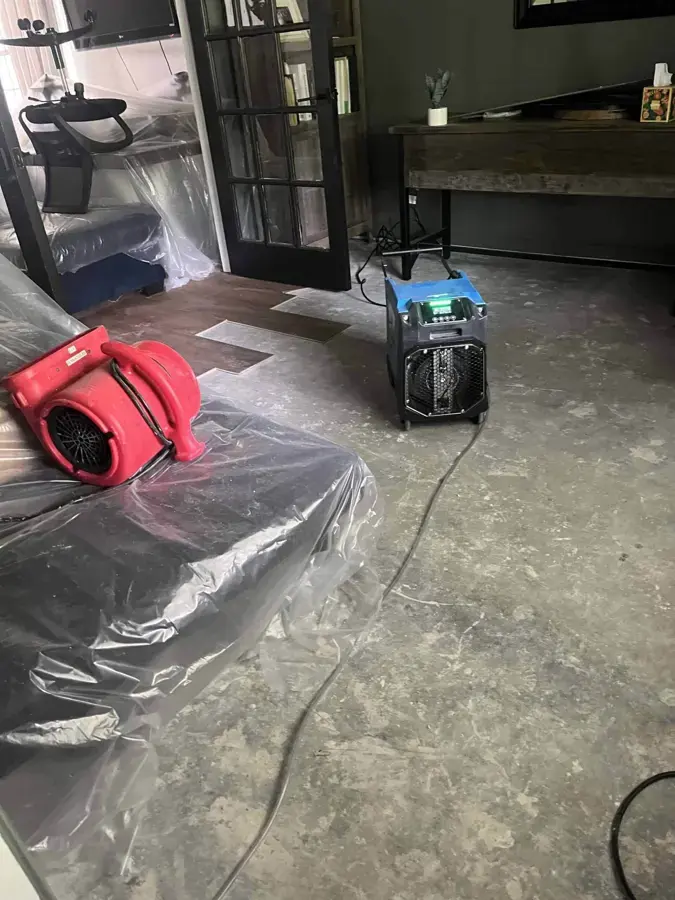
Drying a large footprint building
A small drying job can be handled with a few pieces of equipment in one room. A warehouse or a multi tenant building needs a plan.
The drying team divides a large space into zones, sets equipment where moisture readings are highest and checks each zone separately. A zone can be finished while another is still wet.
More about how the work is done is on the Grain Valley commercial water damage and structural drying pages.
- Concrete floors are measured and dried slowly.
- Walls, ceilings and framing are checked with a moisture meter and a thermal camera.
- Racking, pallets and stock are moved or raised on blocks.
- Equipment is placed so it does not block loading and exits.
- Readings are logged and shared with the owner.
Keeping a business running during the dry out
Shutting down is the safest choice for a badly flooded space, but many businesses cannot afford a long closure. In a large building, work can often be phased.
The team can dry the wet zone while an unaffected office, dock or shop stays open. Noise from equipment and a few closed aisles are the usual trade offs.
A manager should talk through the plan with the drying team before work starts, including access for deliveries and staff.
- Ask which areas can stay open and which must close.
- Plan deliveries around the equipment and the work zone.
- Keep a person on site who can answer questions from tenants and staff.
- Confirm when the next moisture readings will be taken.
Apartments, Main Street and shared walls
In an apartment building, water travels down through floors and across shared walls. A leak in one unit can reach several others, so the restoration team checks the unit above, below and beside the loss.
On Main Street, older buildings can share a wall and a roof. A leak from one storefront can show up next door, and each owner or tenant may need their own record of what was damaged.
Whatever the building, the same rule applies: stop the water, dry the structure and document everything.
Documentation that supports a commercial claim
Commercial claims often turn on records. The insurer will want to know what was damaged, what it was worth and how long the business was affected.
A manager who keeps a steady paper trail makes the claim simpler for everyone. The restoration team's daily logs and moisture readings fit into that file.
Related pages on commercial water damage in Blue Springs cover the same steps for businesses across the area.
- Inventory lists with counts and values for damaged stock.
- Photos and video taken before anything is moved.
- Invoices for emergency repairs and equipment rentals.
- Records of lost hours, closed areas and tenant complaints.
- Copies of the lease, the policy and any notices sent.
What to ask when comparing a restoration team
A manager comparing teams should ask how they document moisture and what they plan to do for a business that stays open. A few pointed questions help.
The answers show whether the team has handled a large building before.
- How will the loss be mapped and how often will readings be taken?
- How will stock, records and electronics be protected?
- Can the work be phased so part of the building stays open?
- What reports will the owner and the insurer receive?
Questions
What should a business do first after a water loss?
Stop the water source, keep people away from wet electrical areas, protect inventory and records, and photograph everything before moving it.
Can part of a warehouse stay open during drying?
Often yes. The drying team works in zones, so a dry office or dock can stay open while the wet area is dried.
Who pays for water damage in a leased space?
The lease and the policies decide. A landlord may handle the roof and building, while a tenant handles stock and improvements.
How do I know the building is dry?
The drying team takes moisture readings each visit and stops when they meet the dry standard for the materials.
Does an apartment leak affect other units?
It can. Water moves through floors and along shared walls, so the team checks the units around the loss.