Basement Flooding Cleanup in Grain Valley, MO
The extraction crew gets the water out of the lower level, the drying team dries the concrete, walls and framing to the IICRC S500 goal, and each reading goes into the claim file, 24/7.
(888) 603-7319Lower level flooded? Call the crew now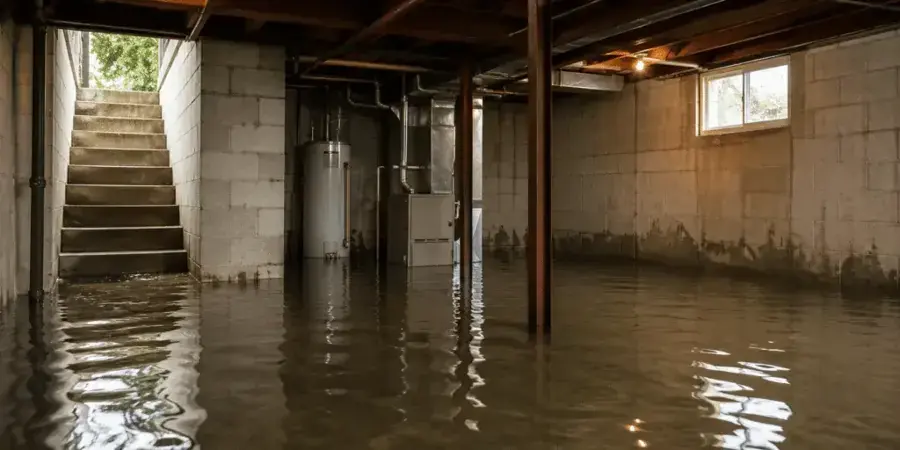
First steps for basement flooding cleanup in Grain Valley
- 1
Shut off power to the lower level
Turn off those breakers only if the panel is dry and you can reach it without stepping into water.
- 2
Look for the source
Check the sump pit, any floor drain and the walls to see where the water is getting in.
- 3
Move belongings up
Carry boxes, rugs and electronics upstairs or onto high shelves.
- 4
Photograph the wet marks
Capture wide and close shots of the wet walls and the floor before anything gets moved.
What does basement flooding cleanup cost in Grain Valley, MO?
Basement flooding cleanup in Grain Valley typically runs $2,500 to $11,000. A bare lower level with clean water sits near the low end; finished rooms with carpet, drywall and soaked concrete sit near the high end.
Bare lower level, clean water
- Water pulled off the concrete
- Dehumidifiers and air movers
- Concrete readings each day
Finished lower level
- Carpet, pad and lower drywall removed
- Drying inside wall cavities
- A moisture map for the claim
Drain or outside flood water
- Containment and HEPA air scrubbers
- Porous materials taken out
- EPA-registered antimicrobial
Ranges are typical, not a quote: the water category, the wet square footage, the material class and how fast drying started move the number most. Run the water damage cost calculator for a closer planning range.
How basement flooding cleanup is handled in Grain Valley
- 1
Map the lower level
Meters and a thermal camera show the walkthrough tech how far water reached into concrete, walls and framing.
- 2
Get the water out
Standing water comes off the floor and out of the carpet first, using truck-mounted or portable extraction.
- 3
Pull what cannot dry
Soaked pad gets bagged and drywall gets cut low so air can reach inside the wall cavities.
- 4
Dry and confirm
Dehumidifiers and air movers keep running, with readings each day, until concrete and walls test dry.
Water that reaches a lower level in Grain Valley spreads across concrete, under wall plates and into carpet pad. The extraction crew starts by finding where it came from, because creek runoff, a pit overflow and a drain backup each change the cleanup.
Where lower-level water comes from in Grain Valley
Sni-A-Bar Creek runs through the city to the Missouri River, and a USGS study with the city mapped 100-year floodplains on its tributaries. Heavy rain near those floodplains, including the area around Buckner Tarsney Road, sends outside water toward homes.
Inside the house, a split pipe after a freeze, a failed water heater or a sump pump failure puts water on the floor just as fast.
- Outside runoff near creek floodplains
- Pipes split by freezing and thawing
- Water heater and washer failures
- Floor drain backups during heavy rain
What comes out and what gets dried
Soaked carpet pad nearly always comes out, and carpet touched by outside or drain water goes with it. The mitigation team cuts wet drywall above the water mark so the insulation and studs behind it can dry.
Concrete floors and block walls are Class 4 materials that release water slowly. The drying team adds dehumidifiers built for dense materials and tracks the concrete with readings rather than touch.
Lowering the risk next time
Downspouts that empty away from the walls, a yard that slopes away from the house and a backup for any sump pump cut the risk. The city map carries a FEMA flood layer for checking a property, and the basement flood risk check gives a quick read.
Wet materials should be drying inside 24 to 48 hours to stay ahead of mold, so the response team treats a flooded lower level as urgent.
Basement flooding cleanup across Grain Valley and nearby towns
The restoration team handles flooded lower levels across ZIP 64029, from Rosewood Hills, Woodbury and Creekside Village to Sni-A-Bar Farms, Greystone and Farmington Meadows, including homes near the Sni-A-Bar Creek floodplains and along Buckner Tarsney Road.
The same service nearby: basement flooding cleanup in Blue Springs, Oak Grove, Independence.
Water damage restoration in Grain Valley · every town covered
Related water damage services in Grain Valley
Basement Flooding Cleanup questions in Grain Valley, MO
How fast does a flooded lower level need attention?
Drying should be underway within 24 to 48 hours. After that the mold window opens and more of the room has to be torn out.
Can carpet in a flooded lower level be saved?
Sometimes, when the water was clean and extraction came quickly. The pad under it is almost never kept, and any carpet that drain or outside water reached goes to the curb.
Why does concrete take so long to dry?
Concrete holds moisture deep in the slab and lets it go slowly. Desiccant or LGR dehumidifiers pull it out over several days, tracked with readings.
Does insurance cover a flooded lower level in Missouri?
Coverage turns on the cause: burst pipes are often covered, sump overflow and sewer backup usually require an added endorsement, and outside flood water falls under a flood policy. Your own insurer has the answer for your policy.
Is a home near Sni-A-Bar Creek at higher risk?
Parts of the city sit in mapped 100-year floodplains along the creek tributaries, and the city map has a FEMA flood layer for checking a property.
How is the cleanup priced?
The bill tracks four things: what kind of water it was, how many square feet got wet, how much finished space was involved and how soon drying began.
Flooded lower level in Grain Valley? Call now.
Water left on concrete keeps wicking into drywall and framing. The restoration crew serving Grain Valley removes it, dries the structure to the S500 goal and records every reading for the insurer.
(888) 603-7319Start the Grain Valley dry-out