Appliance and Supply Hose Leaks in Grain Valley, MO
A split washer hose or a leaking dishwasher can wet a floor quietly. The Grain Valley pros extract the water, check cabinets and walls and dry what it reached.
(888) 603-7319Grain Valley appliance leak help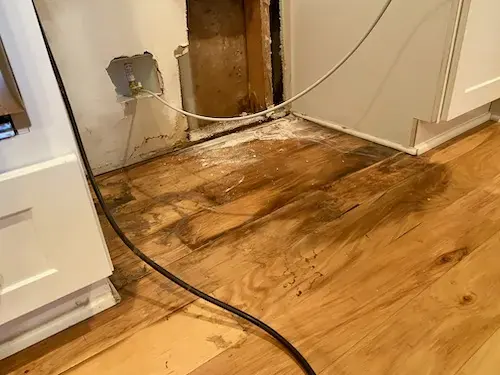
First steps for appliance and supply hose leaks in Grain Valley
- 1
Turn off the valve
Close the shutoff behind the appliance, or the main valve if it will not close.
- 2
Cut the power
Switch off the breaker for the area before touching a wet appliance.
- 3
Mop up and lift items
Soak up surface water and lift rugs and boxes off the wet floor.
- 4
Photograph the source
Record the hose, the appliance and the wet area for the claim.
What does appliance and supply hose leaks cost in Grain Valley, MO?
Cost rises as the water reaches more rooms. A small kitchen leak is the least, a laundry room loss adds subfloor work, and leaks that reach a ceiling below cost the most.
Small kitchen leak
- Extraction of surface water
- Cabinet base drying
- Moisture readings
Laundry room loss
- Pad and lower drywall removed
- Subfloor drying
- Daily logs
Two levels affected
- Ceiling below opened
- Multi-room drying
- Full claim file
Ranges are typical, not a quote: the water category, the wet square footage, the material class and how fast drying started move the number most. Run the water damage cost calculator for a closer planning range.
How appliance and supply hose leaks is handled in Grain Valley
- 1
Locate and stop
The crew finds the failed hose or appliance and makes sure the water is off.
- 2
Extract the water
Standing water is pulled from flooring and cabinet bases.
- 3
Open wet areas
Toe kicks, wet pad and lower drywall are removed where they cannot dry.
- 4
Dry and record
Air movers and dehumidifiers run, and readings are logged until dry.
Washer hoses, dishwasher connections, refrigerator water tubing and ice makers all sit under pressure, and any of them can fail. The leak is often hidden behind the unit, so the first sign may be a soft floor.
Why newer homes still leak
Grain Valley grew a great deal, and much of its housing is newer suburban construction with many modern appliances. New homes still depend on rubber hoses and plastic fittings, which wear out or loosen like any others.
Laundry closets and kitchens are the usual spots, and water can run under cabinets or flooring before it shows.
- Standing water extracted
- Cabinet base and toe kicks checked
- Wet pad and lower drywall removed
- Subfloor dried in place
Upstairs laundry, downstairs damage
A washer on an upper floor can drip through the subfloor into the ceiling below. When two levels are wet, the work grows to include the ceiling cavity, as described in ceiling leak water damage.
Hard flooring such as laminate may cup or lift when water sits beneath it, so the team measures moisture under the surface before deciding what stays.
Finishing the job
Air movers and small dehumidifiers dry the cabinet base, the subfloor and wall bottoms. Readings are recorded each visit, and structural drying continues until the structure tests dry.
The failed hose or appliance should be replaced before the room is dried, so water does not return.
Appliance and supply hose leaks across Grain Valley and nearby towns
Appliance leak cleanup covers homes across the 64029 ZIP code, including townhomes in Greystone, higher-density homes in Creekside Village and houses in Sni-A-Bar Farms, Woodbury and Rosewood Hills, as well as Downtown Grain Valley, Breezeway and Blue Branch. Farmington Meadows is covered too.
The same service nearby: appliance and supply hose leaks in Blue Springs, Oak Grove, Independence.
Water damage restoration in Grain Valley · every town covered
Related water damage services in Grain Valley
Appliance and Supply Hose Leaks questions in Grain Valley, MO
How does a hose leak go unnoticed?
Water often runs behind or beneath the appliance. Cabinet bases and subfloors absorb it quietly, so the first sign may be a musty smell or a soft floor.
Is the water from a washer or dishwasher clean?
Supply water is clean, but drain water from a dishwasher or washer is dirty. The category changes how materials are handled.
Can cabinets be saved?
Often yes if only the base got wet and it dries quickly. Swollen particleboard is usually replaced, while solid wood can frequently be dried.
Should the appliance be moved?
Moving it lets the crew dry beneath it. A technician or plumber should disconnect it safely first.
What should be kept for the claim?
Photos, the failed hose, the appliance model and the drying log. The cleanup team provides readings and a removal list.
Dry the floor and cabinets
The local water damage experts extract the water, open wet cabinet bases and dry the subfloor, then deliver photos and readings for the insurance claim.
(888) 603-7319Start leak cleanup